Tuesday, February 28, 2006

Portland trip

We had a great long weekend in Portland, and I thought I'd share some of the places we discvovered so that you can check them out if you go.

5th Avenue Suites:
This was our 2nd stay here. Reasonable rates, a great location in downtown Portland within walking distance of many things below. Friendly service, very nice suites, they have free WiFi and daily wine reception (which I haven't tried yet...)

Teuscher:
Yummy Swiss chocolate truffles! We stumbled (we do a lot of that) upon a Teuscher store in San Francisco a few years ago and fell in love with their truffles, so now I make a point of visiting their stores whenever I can. I still like their champagne truffles best...

Portland Art Museum:
They currently have an exhibit of artwork and antiques from the house of Hesse (think the Hessian from "The Legend of Sleepy Hollow"). The exhibit is incredible - I think I enjoyed the everyday objects from their houses as much as the paintings, but this one is a stunner. (More pics here). Sadly we spent so much time on it that we didn't get to see the rest of the museum. We'll have to go again!

Plainfield's Mayur:
A good Indian restaurant with a nice veggie selection. The food was good, but not stellar, so if you're expecting something like Bukhara, you'll be disappointed. An insane wine list! (Would you drink a fine Bordeaux with Indian food, though?)

Caprial's Bistro:
A nice suburban bistro with a simple menu. I can recommend the house salad and seasonal fish (escarole). Other items were not as good (chickpea stew and the lemon chiffon & white chocolate dessert). Their cocktails are yummy (Alyssum had the Chocolate Orange Martini), and I discovered a superb new blonde ale from Bridgeport - Supris.

Mother's Bar & Bistro:
We went here last time we visited Portland and loved it. This time they are in the middle of a relocation/remodel, and were temporarily serving breakfast in a nearby restaurant. The atmoshpere was not as good, but the food was still good (maybe not quite as good as the previous time) and service was spotty. We'll give them a try again once they're in their new location.

Powells:
This is not a realy discovery - no trip to Portland is complete without a trip to Powell's.
I stumbled upon a cool series of manga books about the Buddha. Sadly they didn't have volume 1 (there are 8 volumes!), so I'm thinking of ordering vol 1 online and then seeing if it is as good as it seems.
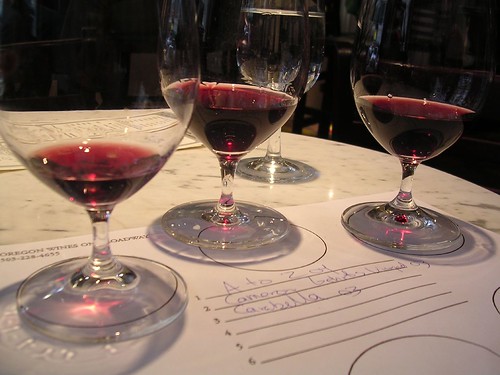

Oregon Wines on Broadway:
Somehow this got deleted when I published this entry initially.
This is a charming little wine bar on Broadway (near Teuscher), small and cosy with a few comfy booths and the more outgoing patrons chatting at the bar. They specialize in Oregon Pinot Noirs and have a great selection. They also have 36 or so wines open and available by the glass or to taste (DIY flight of wine). I tried 3 pinots: 2004 A to Z, 2003 Cameron something-or-other, 2003 Carabella
The A to Z was the lightest and least impressive, and the Carabella was my favourite - almost chocolatey, smooth and powerful.

Thursday, February 23, 2006

Tsotsi

Some lekker news! "Tsotsi", a South African movie, is one of the contenders for Best Foreign Film at this year's Academy Awards. See the Official website, Miramax website.
  • Tsotsi is township slang for a thug or gangster. Tsotsies speak their own dialect of slang called Tsotsi Taal. Another distinct kind of slang called "gamtaal" comes from Cape Town, mainly used by coloureds* - here's a list of some of the words.
  • The film is based on the novel by Athol Fugard, one of South Africa's most famous playwrights.
  • I remember the writer-director, Gavin Hood, from his first big break on SABC TV in a soap-opera about rugby players called "The Game". Here's an older interview with him about his breakthrough from TV into film, and another about his short film "The Storekeeper".
  • Gavin was also in what sounds like a dreadful Hallmark miniseries of "King Solomon's Mines" - Patrick Swayze played Allan Quartermain.
  • NPR's Morning Edition interviews Gavin Hood and lead actor Presley Chweneyagae here.
  • The movie should open in Seattle this Friday, but I'll have to make a date to see it next week some time.
I'm really looking forward to seeing the Oscars this year, partly because of this, but also because John Stewart is hosting!

* This term gets raised eyebrows from my American friends, but is still the term used inside South Africa, even by coloureds when describing themselves...

Random links and musings

Some random links and musing today...
  • Volkswagen has a funny advertising campaign, Un-pimp my ride
  • Thomas Jefferson's love affair with wine
  • Acidity makes wine delicious
  • Steph gives Salish Lodge a thrashing in her Valentine's Day review. To be fair, M+S are incredibly hard to please... I've been here only once and thought it was good, but overpriced. Their hot chocolate is absolutely incredible, though - think Starbuck's Chantico but better, and made at your table. We asked if we one could come just for dessert, but the waiter snootily said that luxury was only available to guests staying in the lodge. (Dumb attitude...)
    Have you been to Salish Lodge? What did you think?
  • We're off to Portland tomorrow for a long weekend. This will be my second visit to the city, and I'm looking forward to visiting Powell's, the Japanese garden, and exploring downtown on foot. Perhaps I'll post pics next week :)

Friday, February 17, 2006

Cheese and wine reunited after brief hiatus

There was a minor upset in the wine bogging sphere last month when a university study supposedly concluded that red wine and cheese did not mix well. The same sentiment was echoed in Kevin Johnson's book "How to Enjoy Your Wine", in which (if my memory serves me well) that most reds don't pair with strong cheeses well, and a better pairing is a sweet white wine like a Sauternes.

Well, trusty Slate sets the record straight: Say Cheese! Turns out it goes fine with red wine.
when I spoke Tuesday with professor Hildegarde Heymann, who supervised the study, she told me that the New Scientist had misinterpreted the results, which will be published in full next month in the American Journal of Enology and Viticulture (alas, not available on newsstands).

Thursday, February 16, 2006

Great moments in online advertising


When I saw this ad fromTelkom I did a double-take...


Is that Einstein?!
Why does he look a frozen zombie?
Does Telkom think ghoulish physicists would inspire me to use them for my Internet access?

Perhaps it's the truth-in-advertising laws forcing them to reveal you will most likely be long-dead before they arrive to install your service... :P

Wednesday, February 15, 2006

Happy belated Valentine's Day

I hope you had a good one!

Mine was wonderful... We decided to stay home this year, and I made dinner for A. Here's the menu:
  • steamed artichokes with jalapeno tartare sauce
  • crusty french bread with soft blue cheese (duh, I forgot the name)
  • fresh tagliatelle with Field Roast Mediterranean sauce (here's the recipe)
  • chocolate petit fours and an apple tartlet shared for dessert
  • accompanied by a 1/2 bottle of 2002 Tenuta Le Velette Il Raggio. (I added a tasting on CellarTracker too)

Tenuta Le Velette have a holiday house that looks really cute - perhaps I'll get the chance to visit the area and stay there one day?

More on television during the apartheid era

(It looks like this didn't get posted for some reason when I tried last week - trying again...)

Wikipedia rocks!
In a comment to this post, Joy asked why it was that American TV shows were shown in South Africa during the apartheid era... I didn't know, but it seems there are two main reasons:

1. The US actors and related unions/guilds did not declare a ban on their works being exported to South Africa. (If you find information to the contrary, let me know...) The British Equity actors union did enforce a ban. (British and American actors and musicians resolved not to perform in South Africa, although some infamous breaches of this occurred...)
In 1976, Equity in Britain decided to introduce a policy of refusing permission to sell programmes featuring its members to South African television. The Council of Equity also reaffirmed its policy to advise its members not to work in South Africa.

In October 1981, the board of the Associated Actors and Artists of America - an umbrella organisation of all major actors’ unions with a total membership of over 240,000 actors - took a unanimous decision that its members should not perform in South Africa.

2. From this wikipedia article:
The availability of US programming was partly the result of a co-operative venture with Universal Studios in 1980 where an episode of Knight Rider was filmed in the Namib desert in South West Africa (today Namibia), and local acting talent was involved in the filming. As a direct consequence, the SABC received the right to broadcast in American programming syndicated from Universal Studios/MCA, and through them purchased material from other studios.

Links:
http://en.wikipedia.org/wiki/South_African_Broadcasting_Corporation
http://en.wikipedia.org/wiki/Television_in_South_Africa

Friday, February 10, 2006

Interview with Bernard-Henri Levy

KUOW's Weekday had a great interview with the French philospher & author Bernard-Henri Levy (BHL). Listen to the MP3 podcast here. I really enjoyed listening to him...

And here's a review in the NYT of BHL's book, by Garrison Keillor (registration required or use cyberpunk/cyberpunk). Oh dear... Garrison doesn't have kind things to say! Here's a brief excerpt form his review:

...but there's nobody here whom you recognize. In more than 300 pages, nobody tells a joke. Nobody does much work. Nobody sits and eats and enjoys their food. You've lived all your life in America, never attended a megachurch or a brothel, don't own guns, are non-Amish, and it dawns on you that this is a book about the French. There's no reason for it to exist in English, except as evidence that travel need not be broadening and one should be wary of books with Tocqueville in the title.


Still, the interview was refreshing - lots of frank thoughts on the current outrage over the cartoons of the prophet Mohammed, the French riots and hurricane Katrina, and the "New" Democrats...

Thursday, February 09, 2006

In shaving, as in life, more is better

In America, people seem to often think more is better. Larger portions of food, bigger houses, bigger engines in their cars, and bigger cars. So, it is not that surprising to see the arms-race over razors:

The history of razors:
1850's: Invention of the safety razor
-1900s: Cut-throat razors common. A single blade, often wielded by a crusty old barber.
1903: Safety razor with disposable blades invented by King Camp Gillette. (I'm not making that name up). Introduction of mass-produced razors, and the business model of making money off of disposable blades.
1930s: Electric razor invented by Jacob Schick.
Later: Two-blade disposable razors. The war between Gillete and Schick begins, with new razor versions appearing almost every year.
Then: After years of advanced research, Gillette unveils the three-blade razor, Mach III. Blade cartridges reach stratospheric prices.
But: Schick fights back with four blades, the Quattro. Schick and Gillette offer razors with tiny motors to simulate the old crusty barber with shaky hands from the 19th century.
Prophetically: The Onion publishes an article predicting the next logical development: Gillette going to five blades!
Make it so: On Superbowl Sunday this year, Gillette finally unveiled their Fusion razor with five blades. Do I hear six blades from Schick? Dr. Seuss might have penned a line or two about that... "Slick Schick stick six ..."

NPR's Steve Inskeep bravely put the new 5-blade razor to the test.

Monday, February 06, 2006

Vin Diesel, and spilled milk...

Sorry, Julie. Not that Vin Diesel!

This article about turning wine into ethanol to run cars is interesting. Forget about having your car smell of McDonalds fries thanks to biodiesel, maybe the cars of the future will smell of brandy and witblits?
It's somehow sad that surplus wine gets repurposed in this way - imaging all the effort, love and caring that went into growing and picking the grapes, making and storing the wine ... and then, you're reduced to selling it off for pennies a gallon to make cheap fuel.

Still, I guess that is a lot better than what sometimes happens to surplus food. I remember hearing stories about surplus milk in SA being poured out onto the ground. I'm not sure why they couldn't just sell it for less, or make some cheese with it, but then I'm not a dairy farmer... It turns out the Dairy Control Board (a national body to control the price and distribution of dairy products) had something to do with it...

South Africa has also witnessed the destruction of surplus fruit and milk at the behest of control boards in order to keep up prices. Information supplied by the Minister of Agriculture, Mr Uys, in Parliament during the 1968 session revealed that in the four months from 10 October 1967 to 11 February 1968 the Milk Board had issued instructions for some 2,107,000 gallons of skimmed milk to be thrown away in Johannesburg, Pretoria, Klerksdorp, and Bloemfontein. The previous
session, the Minister had stated that more than 500,000 gallons of skimmed milk had been thrown away in Johannesburg and Pretoria between 20 December 1966 and 28 February 1967, on the instructions of the Milk Board. The reason given was 'overproduction'.

More info here (logon required), or cached page here.

Saturday, February 04, 2006

What did you watch growing up?

Often conversation will turn to TV shows that people remember from their childhood. Most of my American friends watched Sesame Street, which for some reason never made it to South Africa. We got to see some of the Muppet movies in the cinemas, but I think the sanctions during the apartheid era kept Sesame Street off our TV screens.

Despite sanctions, we had quite a few American TV shows while I was growing up (British TV shows were almost non-existent though...) So, I remember watching shows like Battlestar Galactica, Space: 1999, Star Trek, Buck Rogers, The A-Team, Airwolf, MacGuyver... Often shows would be dubbed into Afrikaans, especially German shows like Derrick - I guess lip-synching to German was easier. In the late 80's-early 90's they started simulcasting the original English soundtrack on the radio, so you could watch the show in its original language (woohoo!)

Some of the most memorable shows from my childhood are the kids TV shows I watched from the age of 4 or 5. Some were locally-produced children's shows that nobody outside of South Africa probably ever saw, others were imported and dubbed. Here's a brief list, with some of the theme tunes (click on the to hear them)...


Barbapapas (France):
This was one of my favourite shows when I was really young. The main characters are a rubbery family that look a lot like bowling pins, and I ended up getting some as toys.

Noddy (UK) :
Based on the Enid Blyton books. (I also read her "Famous Five" books as a kid).

Haas Das se Nuuskas (South Africa) :
I think I watched this around the 2nd and 3rd grade. Here's an article on the creator, who also created other South African childrens' TV shows, such as...

Wielie Walie (South Africa) :
The most insidious theme tune! The title sequence had a grinning animated monkey atop a rolling a barrel as it rolled down a jungle path. The Afrikaans show was basically a variety show with adult hosts, and puppet animals that all lived in a house together. A talking crow (Karel?) and "sea monster" (Sarel) were the main puppets - the crow would sing and play a small guitar, and the sea-monster would provide the comedy (mainly by being stupid). There was also a talking worm, Bennie Boekwurm (bookworm), who would only appear after being summoned by singing flowers. He'd then pop out of the ground, adjust his horn-rimmed specs, and read a story. A gang of talking socks in a dresser also made regular appearances. Great fun!


Liewe Heksie (South Africa) :
("Dear Witch") A great Afrikaans show based on the books by Verna Vels. The characters were all puppets filmed against a black background, and were surprisingly expressive. (Somehow they would get Liewe Heksie's mouth to dimple at the corners when she smiled). The title character is a young witch that actually doesn't know how to do magic. She somehow always managed to save the day, despite bumbling her way through each adventure.

Maya the Bee (Japan):
I saw this dubbed into Afrikaans... I was surprised to see this was actually made in Japan - I could have sworn it was a from Germany or France. This was one of my favourite early animated shows, featuring a young female bee and her insect friends.
More info here.

Heidi (Japan) :
Again, I saw this dubbed into Afrikaans. The theme tune is in German, but the show is Japanese. Based on the books by Johanna Spyri. I had a Heidi LP as a young kid, probably my first record!


Take Hart (UK):
This was an incredible art show for kids. Tony Hart was a great host and an inspired me to draw and paint, plus he dedicated a few minutes of each show to show a gallery of artwork submitted by his young viewers. His show also featured a claymation animation segment, with a little guy called Morph. Morph was created by Aardman, and Nick Park's first job for Aardman was on the Morph production line. (More here)

Links:
List of lots of SA shows
When local was lekker on SA TV
Early SABC TV nostlagia site

Monday, January 30, 2006

How to get rich, quick!

The other day while browsing in a bookstore, I noticed a new book by Dave Barry: "Dave Barry's Money $ecrets". I found myself laughing out loud and eagerly flipping through the book reading his pithy take on various financial topics.

You can imagine my pleasure when I heard him on KUOW's Weekday yesterday morning, talking about his new book and being generally irreverent. You can listen to a podcast of the show by going here. (He kindly summarises Donald Trump's "How to Get Rich" so you don't need to read it.)

Speaking of financial books, I have "The Undercover Economist" waiting for me at the library. It sounds like it's in the same vein as "Freakonomics", so it should be good.

Making Scents of Wine

If you have a few hundred $$ laying around, and want to train your nose to pick up wine smells, http://www.makescentsofwine.com/ is for you! The list of aromas is impressive...
Or, if you just want to learn how to pick out spoilt wine, they have a 12-pack of "wine fault" aromas, including one called "horse", and another called "glue". (Next time you're caught huffing glue, just say you're developing your sommelier skills!)

Thursday, January 26, 2006

Parody of "The DaVinci Code"

I just noticed that a South African author (Tom Eaton) has written a parody of Dan Brown's wildly popular book:
http://www.kalahari.net/bk/product.asp?sku=28346218&showlargeimage=1&toolbar=mweb
Here's an excerpt. It sounds like fun, but I'll have to read Brown's book first to truly appreciate it. (Or I could maybe cheat and just watch the movie.)

I wonder if he's any relation to my old English teacher?

Monday, January 23, 2006

I'm hung up!

Aargh!! It's stuck in my head! From a review on Amazon:
"Hung Up" starts off with samples from ABBA's "Gimme! Gimme! Gimme!" to jump full fledge into a track that you simply will not be able to sit still through.

God damn, that sample is waaay too catchy! And it's disco! Someone help me!

On an unrelated musical note, I placed an advance order for the new William Orbit CD (first new one in 5 years!), and noticed the new Beth Orton CD is coming out around the same time, so I took a (small) risk and ordered it too. Plus, the new Lemon Jelly (which I've already enjoyed on Hayoo! Music) The final track on Lemon Jelly's new CD features William Shatner, so you know it's good. (Check out Shatner's album "Has Been")

Sunday, January 22, 2006

Blind wine tasting

(updated 1/23 9:42pm - Added the Firesteed Pinot Noir I forgot!)

We had a really fun blind wine tasting on Saturday. Alyssum chose 4 red wines from around the world, and with Raymond's help, wrapped them and re-branded them Mars, Venus, Neptune, Mercury and Pluto.

It was really interesting trying to detect such basic things as grape variety without any extra information to go on. Most of the time I was wrong - guessing that a Cabernet Sauvignon was in fact a merlot, or that a Shiraz was a Cabernet Sauvignon. Next time, I'll review this nice guide to wine varieties and wine tasting how-to. Also see this more complete guide to varieties.

Surprisingly, the tastiest wines were not always from the most lauded winery. The wines and some brief notes:

2004 Rosemount Shiraz Diamond Label, S. Australia:
The best wine of the night for me. I thought this was a California or Washington Merlot - it's definitely more fruity than most Cab Sauv's from the northern hemishpere. A great nose with fruit and spice mixing with some alcohol - you know this is a powerful wine before tasting it. It has a nice full-bodied, velvety feel in your mouth, with red fruit and spice (pepper), a good middle attack of tannins that are very soft and linger for great 30 second or so long finish. A great wine to savour on its own, or to drink with a robust meal of grilled meat or with bread & cheese.

Reading up on this wine on their great website, it sounds like the growing condition in 2004 were not as good as 2002/3, so if you find one of those vintages, definitely try them instead. (it sounds like they usually get more raspberry and fruit in a good year).
Mark's score: 92%

2002 Charles Shaw Cabernet Sauvignon, California:
A surprise for me - I thought I'd be able to recognize "3 Buck Chuck" pretty easily. This one was quite impressive - maybe not as nuanced and powerful as a "great" wine, but at the price it was damn nice. A nice fruity nose with berries and oak, medium-full-bodied, sweet cherry/cassis and soft tannins mixed with some spice. A nice lingering finish.
Mark's score: 89%

2002? Goats Do Roam, W. Cape, South Africa:
Wooho! A South African wine! OK... so maybe that's not so exciting to you! :)
I've actually been to the winery - Fairview - where this comes from. The name is a fun reference to the goats that are raised on the farm to make cheese :

One afternoon, at harvest time, my mischievous son Jason and his friend Justin let the goats out of thier tower and sent them for a walkabout amongst the vines. As in the legend of the Yemeni goat herder, whose roaming flock firs discovered the joys of coffee beands, our goats picked out th best and tastiest fruit. Their choice which includes Pinotage, Shiraz, Cinsault, Grenache and Carignan, serves as our inspritation for this wine.

The "goat towers" are really cute: picture a narrow tall white tower with a spiral staircase on the outside. Great for giving the goats a chance to practice their mountaineering skills, and they have little rooms inside to hang out in when it's nasty outside.

Anyway, back to the wine: This is definitely more funk than the others - the smell is a little musty and reminds me of sweaty feet a little. The taste is medium bodied, fruity and quite spicy (green pepper) with a finish that fades in a few seconds. Not much oak, this is a straightforward expression of the grapes (a blend of many red varieties including South Africa's own Pinotage). The taste is quite unusual, so this stands out a bit from the cheap red blends that try to be smooth and innocuous. It's probably best with food like pasta or pizza.
Mark's score: 80%

2003 Christian Moueix Merlot, Bordeaux:
This is the 2nd label wine from the famous Chateau Petrus estate, and is highly reviewed online. e.g.:


Christian Moueix makes the most expensive red Bordeaux on the planet, Chateau Petrus, which sells for $1000 a bottle in great vintages (1989, 1990 and 1995) and just slightly less in ordinary years. He also makes Christian Mouiex Merlot for about $9 a bottle, and it's great every year. During the tremendous vintages, it's an even better bargain. The price disparity is so great, that it must be a 50th label instead of a second or third. Mouiex's talent and experience making the $1000 wine spill over into the $9 wine, to everyone's delight. It's available literally everywhere around town. [link]
I found it disappointing: not much on the nose, and a thin, unexciting taste with rather harsh tannins. Very dry and atringent. This is definitely not like the fruit-forward merlots from the southern hemisphere, or even the USA. Perhaps this is what "old world" merlot is meant to taste like, but I didn't enjoy it. FYI - Christian Moueix also owns Dominus in California. More info here.
Mark's score: 75%

2003 Firesteed Pinot Noir, Oregon:
This was the final wine, and my notes are a bit sparse. The colour was light red, translucent. The nose showed oak, smoke and light red fruit (raspberries), with a "funky" edge. On the tongue it felt light and the acids and tannins emerged quickly, leaving a harsh, hard short finish. Not much fruit on the palate. Light and fresh, but a little too acidic and harsh for my liking.
Mark's score: 72%

PS: Cabernet and Cabernet Sauvignon are not regions in France. Cabernet is not a grape variety either - it's just a populare shortening of Cabernet Sauvignon (the most widely-planted red grape). Cabernet Franc is another famous .Correct me if I'm wrong :)

Wednesday, January 18, 2006

Tweaked layout

As you may have noticed, I've tweaked the layout of my blog a little. I noticed that Internet Explorer was having problems rendering the front page at certain widths, which caused the entries to be shoved down to below the right-hand "menu". So, I've switched back to the default fixed-width template, and tweaked some old posts to fit.

I should really play with CSS some more and try to understand how to get a variable-width layout that works, but that will have to wait a while...

Friday, January 13, 2006

Oregon's bewpubs

The NYT has a story on Oregon's bewpubs, focusing on Portland. I've been through Portland a few times on my way to central Oregon, and also visited "properly" once. I really enjoyed my visit - the city feel more "European" than Seattle, and the downtown area is fun to explore on foot. Plus, you have an Powell's Books - worth a visit in itself.

Oregon has an interesting beer rule: You can bring a covered container to the pub, get some beer, and enjoy it at home... The law says:

471.253. (1) A brewery-public house license shall allow thelicensee:
(a) To manufacture annually on the licensed premises, store,transport, sell to wholesale malt beverage and wine licensees ofthe commission and export { - no more than 200,000 barrelsof - } malt beverages, as defined in ORS 473.010;
(b) To sell malt beverages manufactured on or off the licensedpremises at retail for consumption on or off the premises;
(c) To sell malt beverages in brewery-sealed packages at retaildirectly to the consumer for consumption off the premises;
(d) To sell on the licensed premises at retail malt beveragesmanufactured on or off the licensed premises in unpasteurized orpasteurized form directly to the consumer for consumption off thepremises, delivery of which may be made in a securely covered container supplied by the consumer;

Macaroni and Cheese

Slate has a fun article titled "Crusty Macaroni and Cheese" - What's wrong with the New York Times' weirdly popular recipe.

The Slate story is a follow-on to this story in the NYT, which includes a recipe for macaroni and cheese that doesn't use any bechamel. It sounds pretty disgusting - just pasta and cheese, with a little milk. It reminds me a bit of the overly-oily dish I had at Purple Cafe a while back...

My mom's recipe was pretty traditional: a cheese sauce made using bechame, some nutmeg, cayenne pepper and strong mustard powder (I think?), with good aged cheddar. I haven't made any myself for ages, perhaps this weekend I'll be evil... (Snowshoeing on Saturday will be a good way to burn off the calories!)

Thursday, January 12, 2006

Blind Eating

From Morning Edition:

Dining by candlelight may be romantic, but it's tastier when there's no light at all. That's what one one French restaurateur, Edouard de Broglie, belives. He will open Dans Le Noir, or "In the Dark," in London, similar to his other light-free restaurant in Paris. His theory is that food is best savored in a kind of blind tasting, using the taste buds only. But food is not always recognized; customers are known to confuse, say, veal with tuna.

Hmm... I could see how removing the visual stimulus would encourage your brain to focus more on the taste, smell and texture of what you're eating, but is the benfit worth the risks? Imaging eating your napkin, or forking yourself in the eye. How do you know when you're done eating? (Do you shove your fingers in the plate and rummage around?)

Besides, I think a large part of the joy of good food is visual, somehow the best meal tastes even better and is more memorable if it beautifully presented. I'll be sticking with normal levels of ambient lighting for now, thank you.


For now, I'll stick withto romantic candle-lit dinners instead of pitch darkness.